Japanese
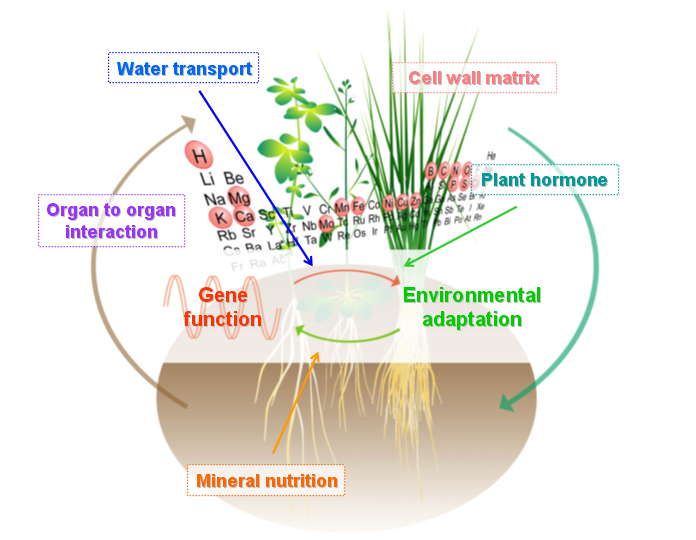
Different from animals, plants cannot move by itself. Therefore, they are always affected by a lot of environmental factors, such as high and low temperatures, water and/or nutrition deficiency and etc. However, by using various mechanisms properly and systematically, plants can survive these stressful environments. Through the research of their environmental adaptation mechanisms, we want to understand their strategies and want to find the way how to utilize their functions in our human activities.In the study of plant environmental adaptation, we are focusing on the relationship between inorganic ions and plant. Under the nutrient deficient conditions, plants activate the mechanisms for acquiring inorganic nutrient ions. On the other hand, under the conditions existing toxic levels of ions, they will activate the mechanisms for sequestration and/or detoxification of excess amount of ions internally and externally. By using these mechanisms, plants can maintain its homeostasis and adapt to the environments. In these adaptations, plant cell wall plays important roles as an interface between plant and environment. In our opinion, the functions of cell wall should reflect the plant strategies how to manage the environment directly. From these view points, we are studying its functions vigorously.
In the plant environmental adaptations, it is often occurred that the perceiving organ is different and apart from adapting organ. For example, the plant perceiving mineral deficiency in the shoot activates mineral acquisition mechanisms in the root. We want to know the mechanisms how to regulate these organ to organ interactions. As a starter, identification of the intercellular messengers, such as plant hormone and glycoprotein, is started.
KEYWORDS
Organ to organ interaction, Transporter,
Metallomics (Ionomics), Phytoremediation,
Cell wall matrix, Apoplast protein